
Many people with Asperger’s syndrome want the same friendships, jobs, and relationships as anyone else. What makes this harder isn’t a lack of interest in connecting with others. It’s the everyday mechanics of social interaction: knowing when to speak, reading a joke, or noticing when someone needs more personal space.
This is where social skills training for Asperger’s syndrome comes in. It teaches the practical tools needed to navigate social situations with more confidence and less guesswork. This guide covers what the training involves, who it helps, the techniques used, and how to know if it’s the right next step for you or your child.
What Is Asperger’s Syndrome?
Asperger’s syndrome describes a point on the autism spectrum typically marked by average or above-average language and cognitive skills, along with challenges in social interaction and communication.
Since 2013, the DSM-5 has classified Asperger’s under the broader term Autism Spectrum Disorder (ASD), often called Level 1 Autism. Many families and clinicians still use “Asperger’s” because it’s a familiar, specific term, and that’s perfectly fine.
Common traits include:
- Strong verbal skills, sometimes with an advanced or formal vocabulary
- Deep, focused interests in specific topics
- Difficulty reading body language, tone of voice, or facial expressions
- A preference for routine and predictability
- Sensory sensitivities to sound, light, or touch
Understanding these traits explains why social skills training is built around specific, learnable patterns rather than general advice.
What Is Social Skills Training for Asperger’s Syndrome?
Social skills training for Asperger’s syndrome is a structured approach that teaches the specific behaviors involved in social interaction, skills many people pick up naturally but that don’t come automatically with Asperger’s.
Instead of vague advice like “be more social,” training breaks interaction into clear, learnable parts:
- Starting and ending a conversation
- Recognizing sarcasm, humor, or figurative language
- Reading facial expressions and body language
- Managing personal space
- Handling disagreements or unexpected social situations
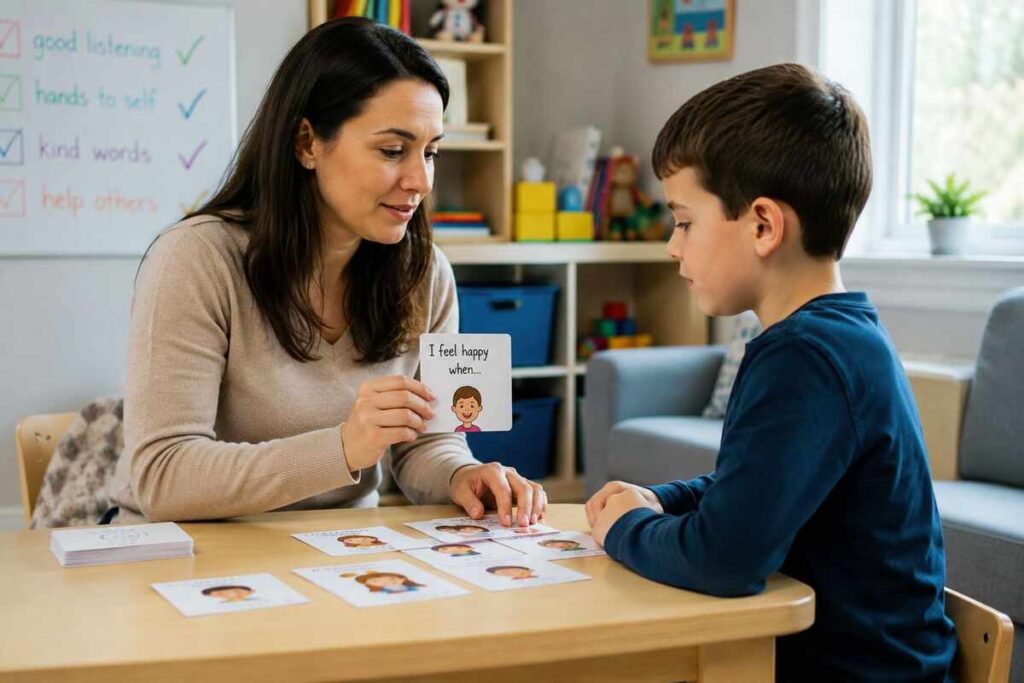
Sessions are usually led by a speech-language pathologist, psychologist, occupational therapist, or trained special education professional, either one-on-one or in small groups. Group settings offer live practice with peers, while individual sessions allow more personalized pacing.
The goal isn’t to make anyone act differently than who they are. It’s to reduce frustration, build confidence, and open doors to friendships, jobs, and relationships.
Common Social Challenges People with Asperger’s Face
Understanding what this training addresses helps explain why it works. These challenges aren’t about a lack of desire to connect. They come from how the brain processes social information.
Common struggles include:
- Missing nonverbal cues, such as a raised eyebrow or crossed arms
- Literal interpretation of language, where idioms like “break a leg” cause confusion
- Difficulty with reciprocal conversation, such as talking at length about a favorite topic without noticing the other person has lost interest
- Trouble in group settings, where unpredictability feels overwhelming rather than exciting
- Difficulty adjusting tone or behavior depending on who they’re speaking with
These are differences in social processing, not character flaws, which is why training focuses on skill-building rather than correction.
Why Social Skills Training Matters for Long-Term Success
Research and clinical experience point to real, lasting benefits:
- Stronger peer relationships. Structured programs help people make and keep friends more easily.
- Better academic and workplace outcomes. Group projects, presentations, and teamwork all rely on social fluency.
- Reduced anxiety. Knowing what to do in a social situation lowers the unpredictability that often causes stress.
- Greater independence in adulthood. Skills like small talk and reading social cues directly affect job interviews, dating, and daily life.
Think of it as a map for social situations that once felt unpredictable. The earlier it’s introduced, the more naturally a person can use it, though progress is possible at any age.
Key Techniques Used in Social Skills Training Programs
Most programs combine several proven techniques rather than relying on just one method.
Role-Playing and Modeling
Therapists demonstrate a social scenario, such as greeting someone new, then guide practice in a low-pressure setting.
Social Stories
Developed by educator Carol Gray, social stories are short narratives that walk through a specific situation, like a fire drill or birthday party, step by step to reduce anxiety through predictability.
Video Modeling
Watching short videos of appropriate social behavior, then discussing and practicing it, reinforces what typical interaction looks like in a concrete, visual way.
Peer-Mediated Learning
In group settings, trained peers model social behavior naturally, giving participants real-time feedback in an authentic environment.
Visual Supports
Charts, cue cards, and diagrams, such as a conversation ladder, give a visual anchor for abstract social concepts.
Social Skills Training for Children vs. Teens vs. Adults
Training looks different depending on age. What works for a young child won’t work the same way for a working adult.
For Children
Training often uses play-based learning, such as games, storytelling, and group activities that make practice feel natural. Parents are usually involved and learn strategies to reinforce skills at home.
For Teens
The focus shifts to friendships, peer pressure, dating, and online communication. Group sessions with same-age peers are especially useful, since social stakes rise sharply in adolescence.
For Adults
Training tends to center on workplace communication, job interviews, relationships, and independent living. Many adults benefit from cognitive-behavioral approaches that pair social coaching with real-time anxiety management.
Age-appropriate training often makes the difference between a program that feels relevant and one that feels frustrating.
What to Expect in a Typical Social Skills Training Session
A typical session, usually 30 to 60 minutes, follows a loose structure:
- Check-in on the week, easing into the session
- Skill focus, introducing one specific skill, such as asking a follow-up question
- Practice through role-playing or group interaction
- Feedback, offering specific coaching on what went well and what to adjust
- Wrap-up, with a small task to practice before the next session
Progress isn’t always linear. Some weeks bring noticeable breakthroughs, others feel repetitive, and that repetition is what builds lasting habits.
How to Choose the Right Social Skills Program or Therapist
Finding the right fit matters more than finding the first available option. When evaluating a program or therapist, consider:
- Credentials. Look for licensed speech-language pathologists, psychologists, or board-certified behavior analysts with autism experience.
- Format fit. Does the person thrive in groups, or would one-on-one coaching work better?
- Curriculum transparency. A good provider can clearly explain what skills they teach and how progress is measured.
- Involvement. The best programs include strategies you can reinforce outside sessions.
- Flexibility. Programs that adjust to individual pace tend to produce better outcomes.
It’s reasonable to ask for an initial consultation before committing. A good therapist will welcome the questions.
Social Skills Training vs. ABA Therapy: What’s the Difference?
These terms are often used interchangeably, but they aren’t the same.
| Social Skills Training | ABA Therapy | |
| Focus | Specific social interaction skills | A broad range of behaviors, including social, academic, and daily living skills |
| Setting | Often group-based, conversation-focused | Typically one-on-one, data-driven |
| Approach | Role-play, modeling, social stories | Reinforcement-based behavior modification |
| Best for | Building conversational and peer skills | Addressing wider developmental goals |
Many families use both. ABA therapy can address broader developmental goals, while social skills training focuses specifically on peer interaction and conversation. The two often complement each other rather than compete.
Simple Social Skills Exercises You Can Practice at Home
Professional training helps, but consistent practice at home reinforces real progress. A few simple exercises to try:
- Conversation ball. Toss a soft ball back and forth, asking a question before each pass, to practice turn-taking.
- Emotion charades. Act out emotions using only facial expressions and body language, then guess what’s being shown.
- Comic strip conversations. Draw simple stick-figure scenes with speech bubbles to map out what someone might say or think in a situation.
- “What would you do?” scenarios. Talk through hypothetical situations, like a friend canceling plans last minute.
- Mirror practice. Practice greetings or introductions in front of a mirror to build comfort with tone and expression.
These work best when framed as games rather than lessons. The goal is comfort and repetition, not perfection.
Signs It’s Time to Start Social Skills Training
Consider starting social skills training if you notice:
- Consistent difficulty making or keeping friends
- Frequent misunderstandings in conversations with peers or coworkers
- Anxiety or avoidance around group activities and social events
- Trouble reading tone, sarcasm, or unspoken social rules
- A clear desire to connect socially, paired with visible frustration when it doesn’t go well
There’s no wrong time to start. Early intervention often builds skills faster, but adults regularly see meaningful progress too. The ability to learn social patterns doesn’t disappear with age.
Frequently Asked Questions
Does social skills training really work for Asperger’s syndrome?
Yes, for most people it leads to measurable improvement in conversation skills, peer relationships, and confidence, especially with consistent practice.
At what age should social skills training start?
There’s no strict age requirement. Many children begin between ages 4 and 8, but training works for teens and adults too.
How long does it take to see results?
Most families notice small improvements within a few months, with meaningful change often taking 6 to 12 months of consistent sessions.
Is social skills training covered by insurance?
Coverage varies by provider and location. Many plans cover it when bundled with speech therapy or occupational therapy, so it’s worth checking directly with your provider.
Can adults with Asperger’s still benefit from social skills training?
Yes. Adult-focused programs address workplace communication, dating, and independent living, and many adults see real progress at any starting point.
What’s the difference between social skills training and social skills groups?
A social skills group is simply one format, peer-based, for delivering social skills training, alongside individual coaching options.
Conclusion
Social skills training for Asperger’s syndrome gives people practical tools for everyday interaction, whether that’s a young child building first friendships, a teenager navigating social pressure, or an adult gaining confidence at work. The best step is simply to start: talk to a qualified therapist, ask questions, and build from there. Progress adds up.