
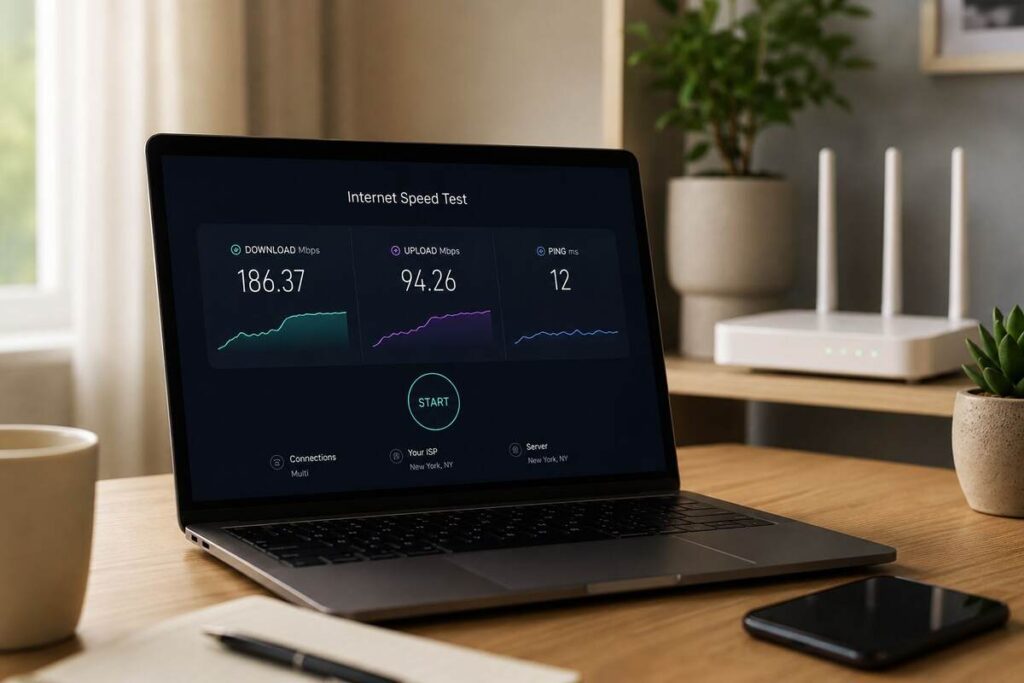
You’re paying for a certain speed every month, but is your connection actually delivering it? That question usually comes up right after a video call freezes or a download stalls. Running a Frontier Internet speed test is the quickest way to find out whether your connection is performing as it should or whether something is holding it back.
This guide covers how to run an accurate speed test, what your results mean, why your numbers might not match your plan, and what to try before calling support.
What a Frontier Internet Speed Test Measures
A speed test checks three things: how fast data downloads to your device, how fast it uploads from your device, and how long a signal takes to make a round trip, known as ping or latency. Together, these numbers show how your connection is actually performing.
This matters because plans are sold based on promised speeds, but what you receive depends on several factors, including your router’s age, how many devices are connected, and even the time of day. A speed test replaces guesswork with an actual number.
For Frontier customers, this is especially useful since Frontier offers both fiber and copper-based DSL connections depending on the area, and the two perform quite differently. Knowing which type you have is the first step to understanding your results.
How to Run a Speed Test on Your Home Network
Running a speed test takes less than a minute, but doing it correctly makes the results far more accurate.
- Use a reliable, well-known speed test tool
- Connect the device directly to your router when possible
- Close other apps and browser tabs using bandwidth
- Pause any downloads, streaming, or cloud backups
- Run the test two or three times and average the results
Testing more than once matters. A single result can be thrown off by a brief network hiccup, so a few readings give a more accurate picture of your typical speed.
Understanding Your Results: Download, Upload, and Ping
Download Speed
This measures how quickly data travels from the internet to your device. It affects streaming, browsing, and downloading files, and it’s usually the number most emphasized in your results, measured in Mbps.
Upload Speed
This measures how fast data moves from your device to the internet. It matters more than people expect, especially for video calls, sending large files, and backing up photos. Upload speed is typically lower than download speed on most plans.
Ping (Latency)
Ping measures the delay between sending a request and getting a response, shown in milliseconds. Lower is better. High ping doesn’t always mean slow overall speed, but it can make calls choppy or games feel laggy even when download speed looks fine.
What Speed You Should Expect From Your Plan
Your plan lists a maximum speed, not a guarantee. According to FCC’s broadband speed guidelines, a fixed broadband connection is now defined as at least 100 Mbps download and 20 Mbps upload, though your actual needs depend on how many people and devices are online at once. A few realistic expectations:
- Wired connections should come close to your plan’s advertised speed, typically 80 to 90 percent under normal conditions
- Wi-Fi connections will usually test lower, depending on distance from the router and interference
- Fiber plans tend to deliver speeds closer to what’s advertised, since fiber isn’t as affected by distance
- DSL plans can vary more, especially if your home is farther from the local network hub
If you’re testing on Wi-Fi and getting 60 percent of your plan speed, that’s often normal overhead. If you’re getting that on a wired connection, it’s worth looking into.
Common Reasons Your Speed Test Looks Slow
A few usual causes are worth checking first:
- Too many connected devices, including smart TVs, phones, and smart home gadgets that use bandwidth even when idle
- An outdated router or modem that can’t handle modern speeds regardless of your plan
- Background updates, including system updates and cloud syncing
- Peak-time congestion, since evening hours tend to see more overall network traffic
- Distance from the router, especially through walls
- Outdated firmware that hasn’t been updated in a while
Testing right after restarting your router, with other devices disconnected, is a quick way to rule out these simple causes.
Wi-Fi vs Wired: Why Results Can Differ
A wired connection will almost always outperform Wi-Fi, since wireless signals lose strength over distance and get interrupted by walls, floors, and other nearby networks.
If you’re testing on Wi-Fi:
- Try moving closer to the router and testing again
- Check whether you’re on 5GHz (faster, shorter range) or 2.4GHz (slower, longer range)
- Test on a different device to rule out a device-specific issue
If your wired speed looks good but Wi-Fi speed is disappointing, your connection is fine. The issue is signal coverage, not your plan.
How to Fix Slow Speeds Before Calling Support
- Restart your router and modem. Unplug both for about 30 seconds, then plug them back in.
- Disconnect unused devices that are still connected but not in use.
- Move your router to a central, open location, away from closets or thick walls.
- Update your router’s firmware through its settings app or admin panel.
- Run a wired test to check whether the issue is your connection or your Wi-Fi coverage.
- Check for outages in your area before assuming it’s a home issue.
If speeds are still noticeably below what you’re paying for after these steps, it’s worth escalating.
When to Contact Frontier Support About Speed Issues
Reach out to support if:
- Your wired speed test consistently comes in well below your plan’s advertised speed after restarting equipment
- Speeds have dropped suddenly with no changes on your end
- You’re seeing frequent disconnections along with slow speeds
- Multiple tests at different times of day all show the same shortfall
Having your test results ready, including the time, date, and whether you tested wired or wireless, helps support resolve the issue faster than a general complaint about slow internet.
Best Times and Tools for Accurate Speed Testing
- Test at different times of day. Results can vary during peak usage hours.
- Use the same tool each time for consistent, comparable results.
- Keep a simple log of your results over a week or two to spot patterns rather than react to one bad test.
- Test before and after changes, such as moving your router or restarting equipment, to see what actually helped.
FAQs
Why is my Frontier internet speed test lower than my plan?
Usually due to Wi-Fi signal loss, too many connected devices, or outdated equipment. A wired connection gives the most accurate picture of your actual plan speed.
Does the time of day affect speed test results?
Yes. Evening hours tend to have more network traffic in most areas, which can lower speeds compared to mornings or early afternoons.
Is a slow upload speed normal?
Yes. Most plans are designed with higher download speeds than upload speeds, since everyday use involves more downloading than uploading.
How often should I run a speed test?
Once a week, or any time you notice a slowdown, is enough to catch ongoing issues.
Does my router affect my speed test results?
Yes. An older or lower-quality router can cap your speeds well below what your plan supports, especially on Wi-Fi.
Can weather affect internet speed?
Rarely for fiber connections. Older copper-based lines can occasionally see minor, temporary disruptions during severe weather.
Final Thoughts
A Frontier internet speed test is a quick way to see what you’re actually getting for what you pay. One low result doesn’t always mean something’s wrong, but a consistent pattern on a wired connection is worth addressing.
Test wired, check different times of day, rule out simple fixes like a router restart, and track your results. If the numbers still don’t add up, you’ll have real data to bring to support instead of a vague complaint, which makes getting it resolved much faster.